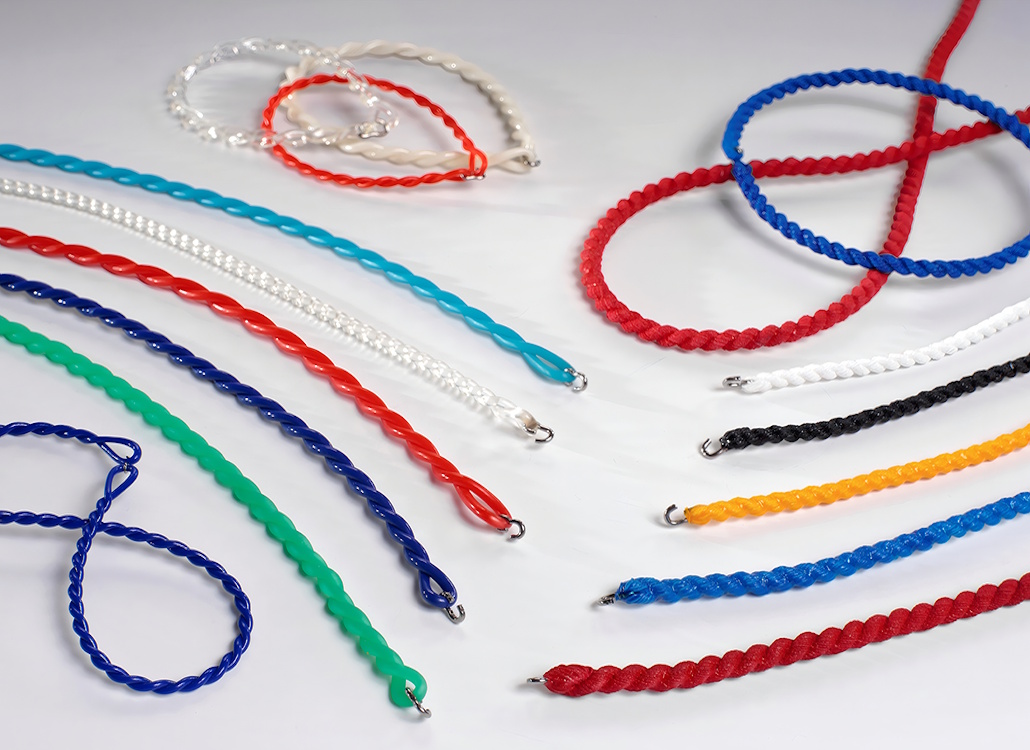
Hook belts are the ideal solution for drive or conveyor systems where multiple belts are installed on a single shaft.
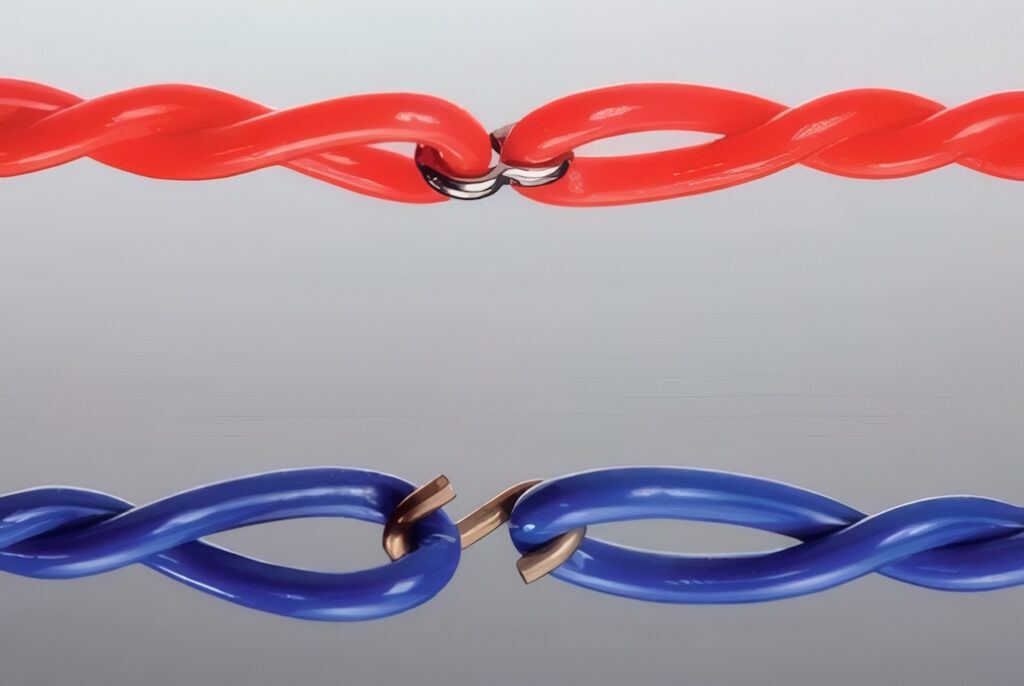
Installation of a Hook Belt
Installation is carried out by feeding the belt into the system. The belt is then connected to the hook, and the second side of the hook is closed using pliers. This eliminates the need for time-consuming and costly disassembly.
Applications
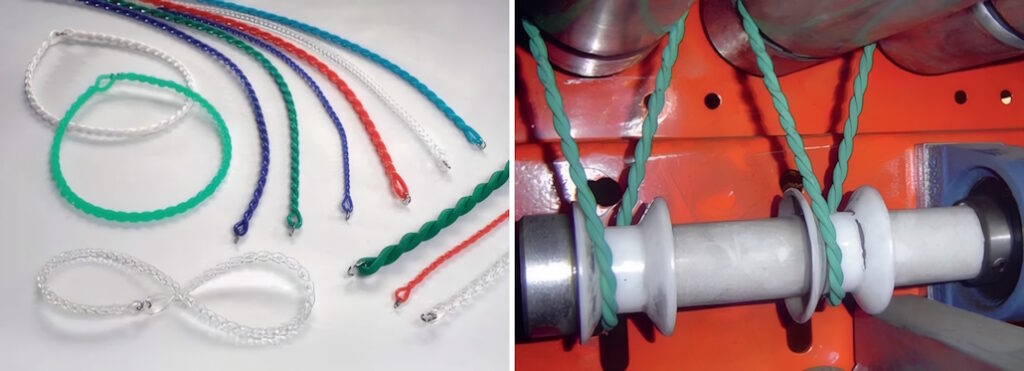
The minimum pulley diameter is approximately 3.5 times the belt diameter. This makes it possible to use small pulley diameters with PU belts in conveyor systems.
PU Hook Belts
| Dimensions: | From 4 mm to 10 mm Ø, with unstretched lengths from 130 mm to 1700 mm LW. |
| Shore Hardness: | Thanks to the wide range of raw materials available to us, we manufacture types ranging from 75° Shore A to 92° Shore A. |
| Surface: | Smooth, with some types also available with a roughened surface. |
| FDA Compliance: | When using 90° V2A stainless steel hooks, the transparent 80° Shore A and blue 85° Shore A types are FDA compliant. |
| Recommended Pretension: | 6 – 12 % |
Textile Hook Belts
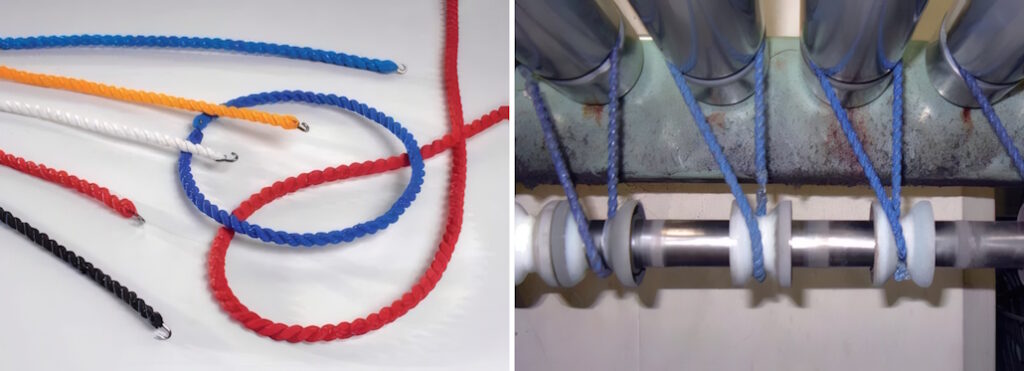
| Dimensions: | From 3 mm to 10 mm Ø and unstretched lengths from 100 mm to 2000 mm LW. |
| Surface: | Thanks to the textile surface, we can apply a wide variety of coatings and thus optimize the belts for individual operating conditions. |
| Recommended Pretension: | 15 – 20 % |
Hook Connections
All belts are available with two different types of metal hooks.
C-Hooks
C-hooks provide the best and most cost-effective standard solution for normal applications.
90° V2A Stainless Steel Hooks
For direct food contact and particularly demanding applications, we recommend using 90° hooks made of V2A stainless steel.
Note: The 90° hooks improve running smoothness by up to 15%.
Download our PDF brochure or explore our products directly: